
The Difference
Why GRIDSTROM Is Different
Most energy infrastructure decisions are made in one system and lived out in another. This is how four common approaches differ across the dimensions that decide whether a capital decision stays connected to the asset it creates.
Direct comparison
Four approaches to the same problem
Each column describes how that approach handles the dimension, in the language teams actually use. Every dimension links to published GRIDSTROM material so you can read the reasoning rather than take a claim on trust.
| Dimension | Spreadsheets & manual processes | Vendor-specific point solutions | Traditional siloed enterprise systems | GRIDSTROMA connected lifecycle platform | |
|---|---|---|---|---|---|
| Cross-functional financial and operational layerDo finance and operations work from the same record?White paper: a financial and operational data model | ManualFinance and operations keep separate files that are compared periodically. | Point solutionsOperating data only; financial context lives elsewhere entirely. | Siloed enterpriseBoth exist in capable systems, joined afterwards by reporting and reconciliation. | GRIDSTROMA shared data model holds financial and operational attributes of the same asset together. | |
| Vendor-neutral asset modelDoes the record survive a change of equipment or supplier?White paper: vendor-neutral device onboarding | ManualEach new asset type introduces another spreadsheet convention. | Point solutionsThe record is defined by, and tied to, one vendor's platform. | Siloed enterpriseAsset structures are often shaped by whichever system onboarded them first. | GRIDSTROMAssets are described in a common model, so mixed fleets and replacements keep one continuous record. | |
| Bidirectional integrationCan information move back out to the systems teams already use?How GRIDSTROM connects existing systems | ManualRe-keying in both directions; the copy and the original drift apart. | Point solutionsTypically read-only exports from the vendor's own environment. | Siloed enterpriseIntegrations are often one-way feeds built per project and maintained separately. | GRIDSTROMGoverned two-way interfaces so information enters and approved outcomes return to the source system. | |
| Data boundaries and validationIs it clear where data lives and whether it can be trusted?White paper: energy data boundaries | ManualOwnership and version history depend on individual discipline. | Point solutionsBoundaries are set by the vendor's hosting and export terms. | Siloed enterpriseEach system applies its own quality rules; conflicts surface during reporting. | GRIDSTROMExplicit cloud, hybrid and on-premises boundaries with validation applied as data is admitted. | |
| Capital governance controlsIs an approved investment traceable to what was actually built?Capital governance on GRIDSTROM | ManualApproval evidence sits in documents and email threads. | Point solutionsOutside the scope of an equipment portal. | Siloed enterpriseApprovals live in finance; execution lives in project and field systems. | GRIDSTROMApproval, assumption and change history stay attached to the asset the capital created. | |
| Lifecycle evidence continuityDoes the decision trail survive from plan to replacement?White paper: audit-ready investment decisions | ManualEvidence is reassembled at audit time from whatever was retained. | Point solutionsCovers the service life of that vendor's equipment only. | Siloed enterpriseContinuous within each system, interrupted at every handoff between them. | GRIDSTROMOne continuous record across plan, finance, approval, procurement, deployment, operation, service and replacement. | |
| Financial-impact prioritisationIs work ordered by what it is worth, or by what arrived first?Product workflows | ManualPriority follows whoever escalates loudest. | Point solutionsAlerts are ranked by device severity, without business context. | Siloed enterpriseEach system ranks within its own queue; cross-system tradeoffs are made in meetings. | GRIDSTROMBecause financial and operational context share a record, work can be ordered by business impact. |
The GRIDSTROM column describes the connected lifecycle architecture the platform is built around, documented in the white papers and architecture material linked above. It is a description of approach, not a list of features available to the public.
What it is for
Outcomes, not feature names
Connected information is only worth the effort if it changes something. These are the outcomes the architecture is designed to produce.
Protect Financial Value
Keep the assumptions behind an investment attached to the asset, so value is defended over its whole life rather than only at approval.
Capital governancePrioritize by Business Impact
Order the day's work by what it is worth to the business, not by which system raised the alert.
Product workflowsSee Risk Earlier
Surface degradation, exposure and drift while there is still time to choose a cheaper response.
Degradation-aware optimizationImprove Asset Availability
Give field work the full history and context of the asset so problems are resolved on the first visit more often.
Use casesGovern Capital Decisions
Make approvals, assumptions and changes traceable, so a decision can be explained long after it was made.
Audit-ready decisionsConnect Finance and Operations
Let both sides read the same asset record, so the operating picture and the financial picture stop disagreeing.
The shared data modelReduce Data Reconciliation
Replace recurring manual matching between systems with information that carries its context as it moves.
IntegrationsScale Without Vendor Lock-In
Add sites, technologies and suppliers without rebuilding the record or surrendering it to one vendor's platform.
Open energy ecosystem
Complex architecture. Simple to use.
GRIDSTROM connects fragmented financial, operational and infrastructure systems, transforms their data into coordinated intelligence, and delivers clear decisions, optimized actions and measurable value.
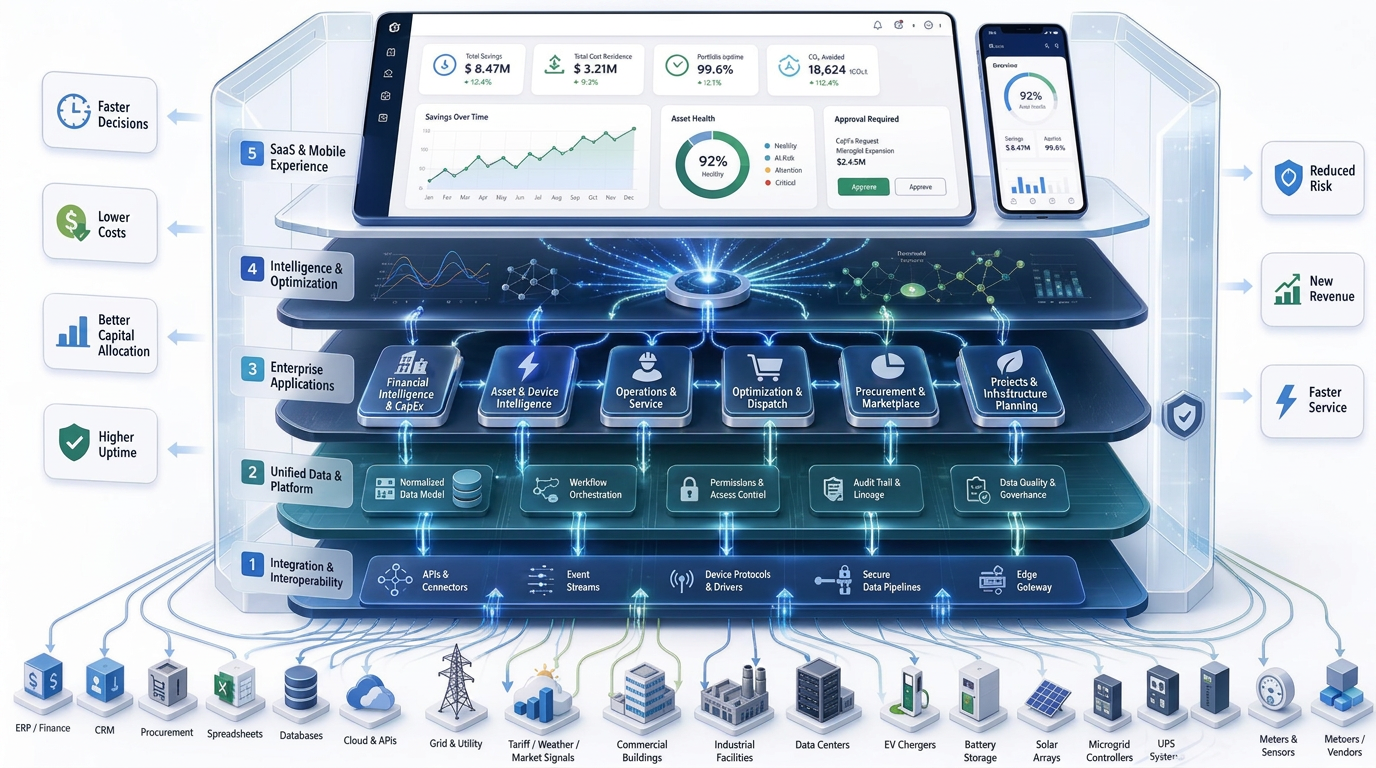
Value emerges above — outcomes produced by the complete architecture
- Faster DecisionsLess waiting on reconciliation
- Lower CostsLess duplicated work and rework
- Better Capital AllocationCapEx tied to asset evidence
- Higher UptimeIssues seen and acted on sooner
- Reduced RiskGoverned, auditable decisions
- New Revenue OpportunitiesOptimization and market value
- Faster ServiceField work with full context
- Greater Customer ValueBetter outcomes delivered
Portfolio dashboard
- Total SavingsTracked
- Total Cost AvoidanceTracked
- Portfolio UptimeHealthy
- Asset HealthMonitored
- Approval Required1 item
- Risk or OpportunityFlagged
Mobile approval
Recommended Action
Storage replacement package ready for review.
- Forecasting
- Scenario Modeling
- Financial Analysis
- Risk & Anomaly Detection
- Asset Health & Degradation
- Recommendations
- Explainable AI
- Automated Optimization
- Financial Intelligence & CapEx
- Asset & Device Intelligence
- Operations & Service
- Optimization & Dispatch
- Procurement & Marketplace
- Projects & Infrastructure Planning
- Unified & Extensible Data Model
- Workflow Orchestration
- Permissions & Access Control
- Audit Trail & Lineage
- Data Quality & Governance
- Rules, Events & Automation
- APIs & Connectors
- Event Streams
- Device Protocols & Drivers
- Secure Data Pipelines
- Edge Gateway
- Bidirectional Sync
Complexity enters below — connected systems, assets and people
- Business SystemsERP, Accounting & FinanceCRMEPM & PlanningProcurement
- Data & CloudSpreadsheets & FilesDatabasesCloud Platforms & APIs
- Grid & MarketGrid & UtilitiesTariffs, Weather & Market Signals
- FacilitiesCommercial BuildingsIndustrial FacilitiesData Centers
- Energy AssetsEV ChargersBattery StorageSolar ArraysMicrogrid ControllersUPS SystemsMeters & Sensors
- People & NetworkPartners, Vendors & Service Providers
Complexity enters below
Business Systems · Data & Cloud · Grid & Market · Facilities · Energy Assets · People & Network
Enterprise systems, field devices and market signals connect through governed, two-way interfaces — information moves into GRIDSTROM and approved actions move back out.
- APIs & Connectors
- Event Streams
- Device Protocols & Drivers
- Secure Data Pipelines
- Edge Gateway
- Bidirectional Sync
1 of 5
Value emerges above
- Faster Decisions
- Lower Costs
- Better Capital Allocation
- Higher Uptime
- Reduced Risk
- New Revenue Opportunities
- Faster Service
- Greater Customer Value
Start a Conversation
See where your portfolio stands
Share the property, portfolio or investment decision you are evaluating and we will explore whether GRIDSTROM is a suitable partner.