
GRIDSTROM Intelligence
The Intelligent Infrastructure Review
AI • Energy • Data Centers • Robotics
Editorial theme
Exploring the AI Energy Ecosystem
Published by GRIDSTROM Energy Solutions for the people who plan, finance, design, procure, build, operate, and communicate major infrastructure — written to be useful to a board and accurate to an engineer.
GRIDSTROM ENERGY INTELLIGENCE
Meet Anders
GRIDSTROM's AI Energy & Finance Analyst
Anders delivers concise briefings exploring the intersection of energy, finance, artificial intelligence, data centers, infrastructure and robotics. Each briefing is researched and editorially reviewed by GRIDSTROM Energy Solutions.
Anders is an AI-generated digital presenter.
Explore the Latest IntelligenceFeatured
The current issue
The lead article of the Review, with original diagrams and a downloadable version.
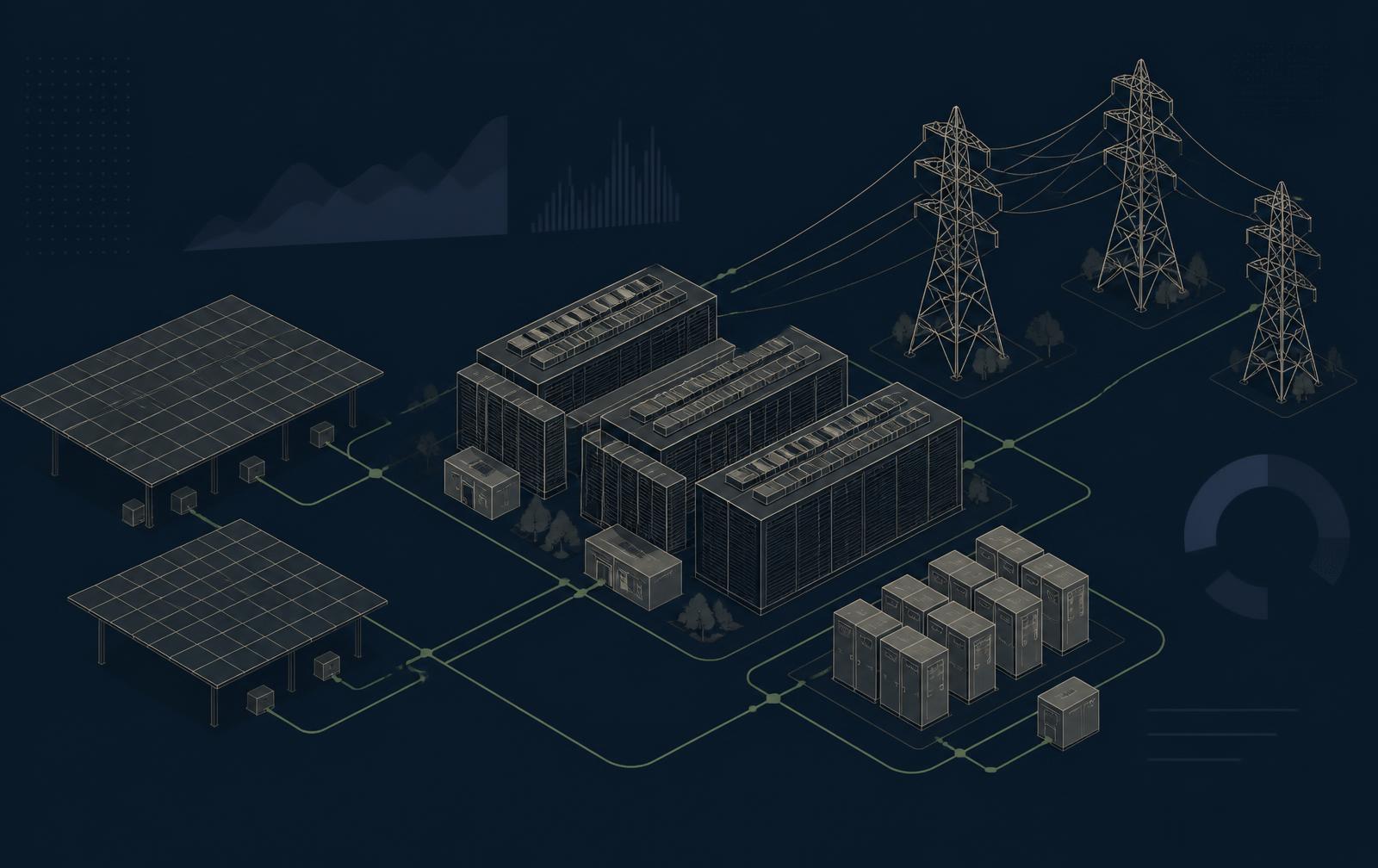
How a Data Center Microgrid Works
One controller, several resources, two operating modes.
A microgrid is a defined set of generation, storage, and load that can run connected to the utility or separated from it. The equipment matters less than the controller: it decides, second by second, which resource serves the load and when to island the site.
GRIDSTROM Intelligence Team4 min read
What Time to Power Means
The clock that decides whether a project happens here or somewhere else.
Time to power is the interval between committing to a site and being able to energize load there. It is the single number most often used to compare locations, and it is set by a sequence of steps that mostly run one after another rather than in parallel.
GRIDSTROM Intelligence Team4 min read
How Battery Storage Supports Data Centers
One asset, four different jobs — and they compete with each other.
Battery energy storage at a data center is not a single-purpose device. The same installation can bridge outages, reduce demand charges, firm on-site generation, or support a utility program. Each role implies a different state of charge, and a battery can only be in one state at a time.
GRIDSTROM Intelligence Team4 min read
Recurring series
Seven series, one publication
Each series has a defined format, a defined audience, and a defined standard: no advocacy, no vendor pitch, and no claim without a stated basis.
Exploring the AI Energy Ecosystem
The flagship series
How energy, data centers, AI, robotics, infrastructure, capital, and communities connect — long-form analysis of the systems that now shape one another, written for the people who plan, finance, build, and operate them.
View the seriesInfrastructure Explained
Plain-language technical explainers
Clear, visual explanations of the systems behind modern energy infrastructure. Written so an engineer finds it accurate and a non-technical stakeholder finds it readable.
View the seriesExecutive Briefs
Decision-ready summaries
Short briefs that give senior decision-makers the structure of an issue — what is at stake, what the options are, and which questions determine the outcome — without requiring a technical background.
View the seriesProject Spotlight
How real projects come together
Structured looks at how infrastructure projects are scoped, financed, engineered, and delivered — the sequence, the decision points, and the constraints that shape the result.
View the seriesMarket Signals
What the market is telling us
A running read on the indicators that move infrastructure decisions: interconnection queues, equipment lead times, capital costs, load growth, and procurement conditions.
View the seriesPower & Policy
Rules, rates, and the public interest
Balanced coverage of the regulatory and rate structures that determine what gets built, what it costs, and who carries the burden — written without advocacy.
View the seriesIndustry Reports
Deeper research, in one document
Longer research documents that consolidate a full topic into a single reference — structured for circulation inside an organization and designed to be read away from a screen.
View the seriesExecutive Briefs
Decision-ready, in two pages
Short briefs that give a decision-maker the structure of an issue: what is at stake, what the options are, and which questions determine the outcome.
Time to Power Is the Binding Constraint
For most large loads today, the limiting factor is not capital or equipment but the date energized capacity is actually available at the site.
Compute, manufacturing, and fleet electrification programs are being scheduled against construction timelines rather than energization timelines. When those two dates diverge, the asset is finished before it can operate, and the carrying cost falls on the owner rather than on the utility or the vendor. Treating the energization date as the project's controlling milestone changes site selection, phasing, and financing structure.
GRIDSTROM Intelligence Team4 min read
On-Site Generation: When It Changes the Business Case
On-site generation is worth evaluating when it removes a schedule constraint, a reliability exposure, or a demand-charge burden — not simply because it is available.
Generation equipment is being proposed to large-load owners as a default answer to grid delay. It is sometimes the right answer and frequently an expensive one. The question is not whether on-site generation works, but which specific constraint it removes and what that removal is worth over the asset's life.
GRIDSTROM Intelligence Team4 min read
Battery Storage as a Commercial Instrument
Battery storage earns its place in a project when it converts a tariff structure, a reliability requirement, or an interconnection limit into a manageable cost.
Storage is now routinely proposed alongside large loads, but the commercial rationale is often left implicit. Because storage revenue and savings depend on tariff design, market rules, and duty cycle, the same system can be strongly economic at one site and marginal at another a few miles away.
GRIDSTROM Intelligence Team4 min read
Reading a Site Through Its Energy Constraints
A site's energy position — available capacity, upgrade path, and delivery schedule — should be evaluated before land economics, because it is the harder condition to change.
Site selection processes still tend to run land, tax, and workforce analysis first and energy analysis last. For large loads that ordering is inverted relative to risk: land terms can be renegotiated, while an upstream capacity constraint often cannot be resolved on any commercially useful timeline.
GRIDSTROM Intelligence Team5 min read
Procurement Lead Times and the Order-Before-Design Problem
When equipment lead times exceed design duration, procurement decisions must be made before the design that justifies them is complete — and that trade-off should be made deliberately.
Long lead times on transformers, switchgear, and other major electrical equipment have inverted the traditional sequence for many programs. Teams either order early and accept specification risk, or wait for design certainty and accept schedule risk. Both are defensible; making the choice implicitly is not.
GRIDSTROM Intelligence Team4 min read
Load Flexibility Without Losing Uptime
Flexibility is worth money to the grid, and the practical question for an operator is which portion of load can move without touching the commitments that matter.
Utilities and system operators increasingly value load that can reduce, shift, or shed on request, and are structuring rates and programs accordingly. For operators with mixed workloads, some flexibility already exists in the operating profile — it is simply not characterized, and therefore not monetized or negotiated.
GRIDSTROM Intelligence Team4 min read
Community Benefit as Risk Management
Community commitments are most durable — and most useful to a project — when they are written into approvals rather than offered as goodwill.
Large loads are approved locally, and local approval is now the most common source of delay for otherwise viable projects. Commitments on workforce, tax base, ratepayer effects, and land use influence both the approval and the operating relationship that follows it. The distinction that matters is enforceability.
GRIDSTROM Intelligence Team4 min read
Buying an Energy System, Not a Collection of Equipment
Procuring generation, storage, charging, and controls as separate packages transfers integration risk to the owner, who is usually the party least equipped to carry it.
Vendor proposals arrive by category, and organizations buy the way proposals arrive. The result is a set of individually sound components with no single party accountable for how they operate together, and gaps that surface during commissioning when they are most expensive to close.
GRIDSTROM Intelligence Team4 min read
Featured visual explainer
The grid-asset model, in one diagram
From Infrastructure Explained: dedicated generation, storage, and microgrid controls sit between the site and the utility connection, so the campus can serve itself and support the grid instead of only drawing from it.
Infrastructure Explained
Clear, visual explanations of the systems behind modern energy infrastructure. Written so an engineer finds it accurate and a non-technical stakeholder finds it readable.
- Microgrids, islanding, and controls
- Battery energy storage sizing and duty cycles
- Interconnection, service capacity, and upgrades
- Distributed generation and on-site resources
Market Signals
What the market is telling us
Interconnection queues, equipment lead times, capital costs, and load growth — the indicators that change what a project can realistically deliver.
Market Signals
A running read on the indicators that move infrastructure decisions: interconnection queues, equipment lead times, capital costs, load growth, and procurement conditions.
Coverage
- Interconnection and queue conditions
- Equipment availability and lead times
- Capital cost and financing conditions
- Load growth and demand patterns
Power & Policy
Rules, rates, and the public interest
Regulatory and rate structures determine what gets built, what it costs, and who carries the burden. Covered without advocacy, with sources stated.
Power & Policy
Balanced coverage of the regulatory and rate structures that determine what gets built, what it costs, and who carries the burden — written without advocacy.
Coverage
- Rate design and cost allocation
- Interconnection rules and tariffs
- Permitting and siting frameworks
- Community and ratepayer protections
Industry Reports
Deeper research, in one document
Longer research documents built for circulation inside an organization — structured, diagrammed, and print-ready.
Available to download now
The current issue of the Review is formatted for print and can be saved as a PDF directly from the article page — a clean, diagram-complete document suitable for circulating to a board, a project team, or a public agency.
Open the issue and downloadThe report program
Longer research documents that consolidate a full topic into a single reference — structured for circulation inside an organization and designed to be read away from a screen.
Subscribers receive each report on the day it is released.
Readership
Written for the whole project table
Senior decision-makers and the professionals who influence, design, finance, procure, build, operate, and communicate major infrastructure projects.
- Data-center developers and operators
- AI and robotics companies
- Utilities and energy providers
- Investors and infrastructure funds
- EPC firms
- Engineers and contractors
- Commercial property owners
- Public agencies
- Economic-development organizations
- Technology providers
- Strategic partners
- Conference organizers and industry media
Subscribe to The Intelligent Infrastructure Review
Three tracks, one publication. Choose what you want to receive — Executive & Capital Brief, Engineering & Deployment Review, or the AI Energy Ecosystem Report.
Beyond the page
Working on a project the Review would cover?
GRIDSTROM Energy Solutions develops and delivers the infrastructure this publication analyzes. If you are evaluating a site, a portfolio, or a partnership, start a conversation with the team.