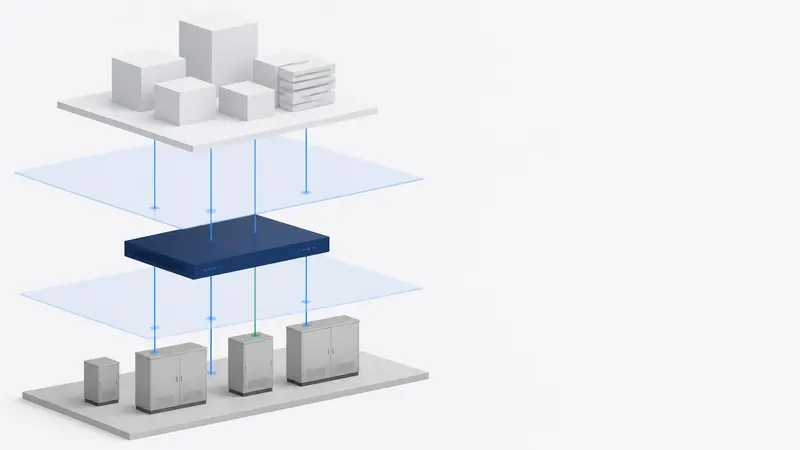
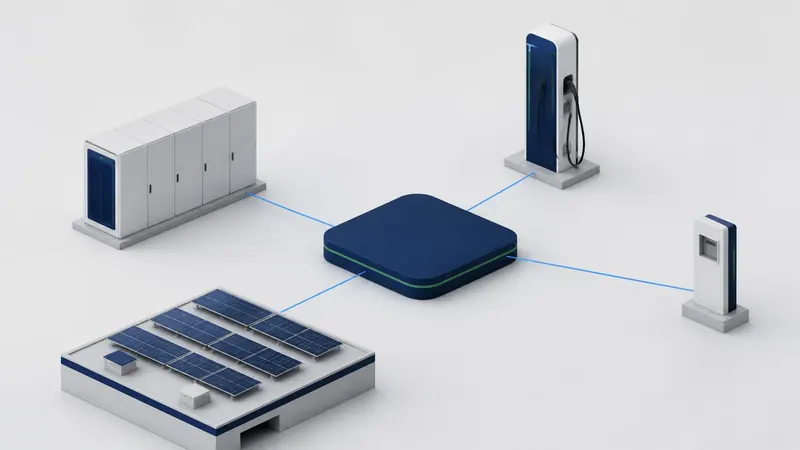
Energy portfolios accumulate equipment across manufacturers, vintages, acquisitions, contractors, and business units. Each system may expose different identifiers, protocols, telemetry, alarms, command models, time conventions, and data quality. A vendor-neutral platform cannot erase these differences; it must isolate and govern them.
The enterprise asset model remains stable while adapters translate device-specific behavior. Supported capabilities are declared per manufacturer, model, firmware, protocol, and deployment—not inferred from a logo.
The onboarding contract
Every onboarding should produce a machine-readable capability contract: identity method, supported measurements, sampling behavior, units, quality flags, alarms, writable settings, commands, safety constraints, authentication, time synchronization, firmware dependencies, rate limits, and recovery behavior.
This contract separates read visibility from control. A device may support monitoring but not remote commands; a site may permit optimization recommendations but require local human execution; an enterprise may allow control only through an existing EMS. The platform must represent these distinctions explicitly.
A staged onboarding workflow
A safe sequence is discover, identify, map, validate, observe, authorize, activate, and monitor. Discovery finds candidate endpoints or files. Identification resolves manufacturer, model, firmware, serial number, site, and enterprise asset. Mapping connects native fields to canonical measures. Validation checks units, ranges, timestamps, completeness, and physical plausibility.
Observation runs the connector without consequential action. Authorization confirms roles, security boundaries, command scope, and rollback. Activation enables approved functions. Continuous monitoring detects drift in credentials, firmware, schema, timing, and data quality.
Canonical semantics and extensibility
Common concepts include power, energy, state of charge, state of health, availability, temperature, status, alarms, operating mode, setpoint, and control permission. Yet semantics vary. State of health may reflect different manufacturer methods; availability may be inferred or explicit; a charger connector state is not the same as site availability.
The model therefore needs a canonical term, source-specific definition, unit, transformation, quality state, and raw-value retention. Extensions should add technology-specific detail without changing core enterprise objects such as asset, site, project, work order, and contract.
Security and operational safety
Credentials belong in managed secret storage, not configuration files or support tickets. Connections require least privilege, segmentation, audit logs, rotation, and explicit ownership. Remote control requires stronger authorization than read access, with limits, interlocks, command validation, rate control, and tested rollback.
The control plane should fail safely. Loss of cloud connectivity must not defeat local protection. A command should be attributable, idempotent where appropriate, time-bounded, acknowledged, and verified against resulting state.
Offboarding is part of onboarding
Vendor-neutral architecture must make exit possible. Offboarding revokes credentials, stops commands, preserves history, exports required records, resolves open work, removes stale endpoints, and verifies that no orphaned access remains. Asset retirement, platform replacement, property sale, and vendor change are distinct scenarios.
The organization should retain the data and evidence it is entitled to keep while respecting licensing, privacy, security, and contractual limitations.
Measuring onboarding quality
Useful measures include time to validated telemetry, percentage of mapped fields with known provenance, unresolved identity conflicts, data-quality exceptions, command success and verification, credential age, schema drift, and completeness of offboarding.
Connector count alone is a poor metric. A smaller number of deeply validated, supportable integrations creates more enterprise value than a broad catalog of ambiguous logos.