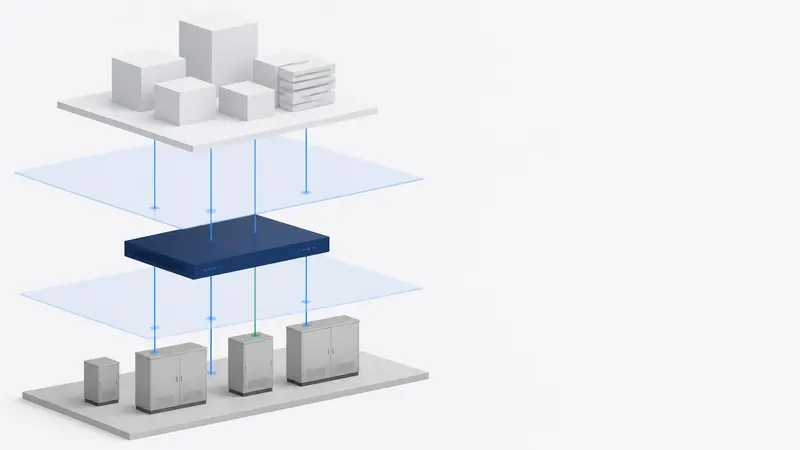
Distributed energy investments usually begin in finance, engineering, facilities, procurement, or a project-development workbook. Once the asset is commissioned, the operating record often moves to a vendor portal, CMMS, ticketing system, or another spreadsheet. The financial model and the operating asset then diverge: assumptions remain in one place while actual condition, utilization, service cost, and replacement decisions accumulate elsewhere.
A financial-operational data model closes that gap by treating planning, delivery, operation, service, and replacement as states in one lifecycle. It does not require a single application to own every datum. It requires stable identity, explicit ownership, time-aware relationships, and governed synchronization among the systems that remain authoritative for their respective domains.
The canonical asset record
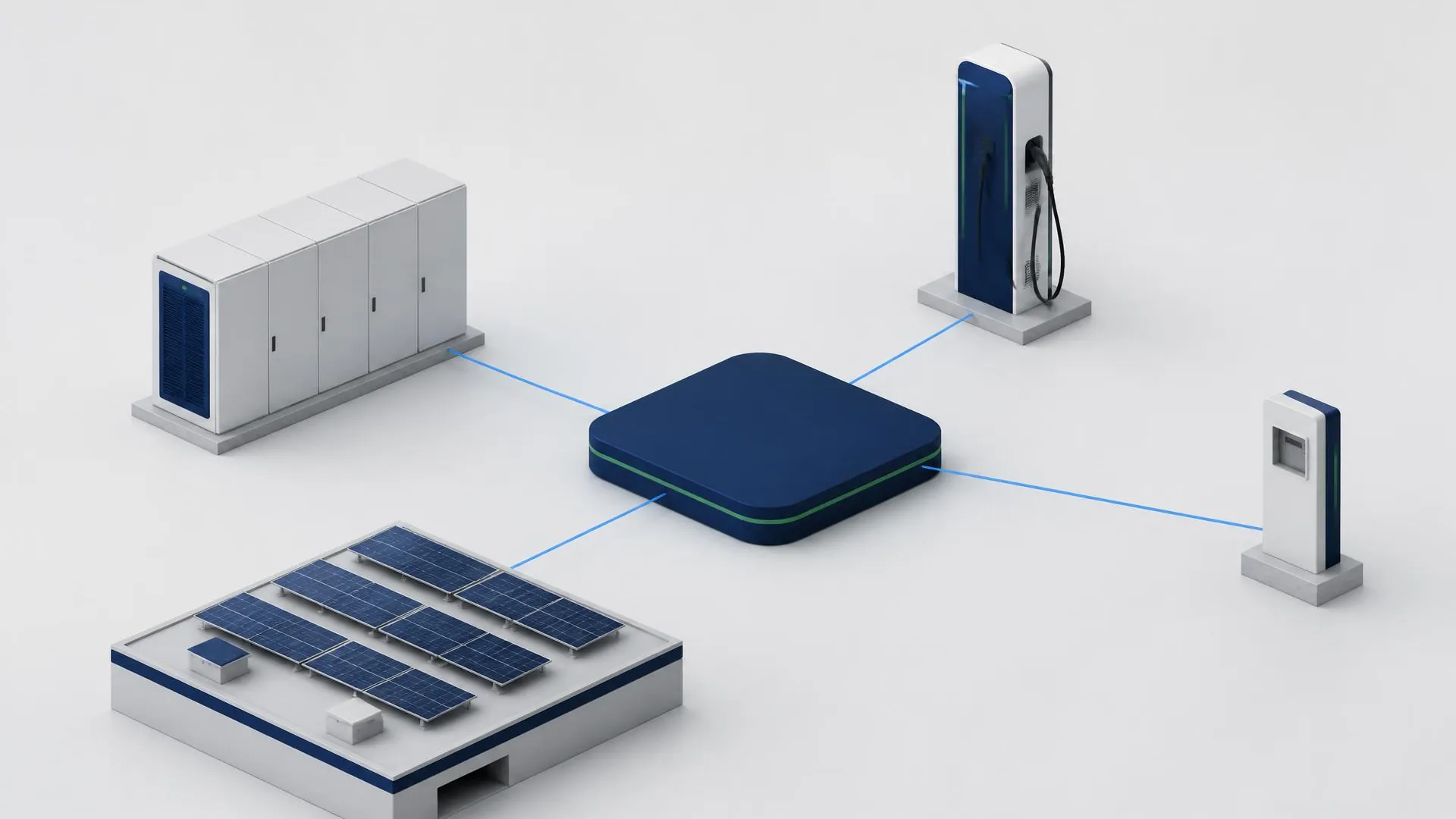
A canonical record should identify the asset and site independently of any manufacturer portal. Its core includes enterprise asset ID, external identifiers, site and electrical hierarchy, manufacturer/model/serial number, ownership and contract relationships, commissioning state, rated capability, configuration, warranty, and lifecycle state. Extensible schemas allow the same pattern to represent chargers, batteries, solar, microgrids, UPS systems, meters, controls, and future capital assets.
The record also links—but does not indiscriminately copy—business context: project and budget, approved scenario, CapEx request, quotes and orders, depreciation class, expected life, service agreements, responsible organization, risk classification, and replacement strategy. Every value needs provenance, effective dates, confidence or validation state, and source-system ownership.
Five linked planes of information
A practical model separates five planes: identity and hierarchy; technical configuration; financial and contractual context; operational time series and events; and governance/evidence. Separating these planes prevents high-volume telemetry from overwhelming transactional records while still allowing decisions to traverse them.
The linkage enables questions that isolated systems answer poorly: Which assets are underperforming the assumptions used to approve them? Which service actions protected the most value? Which replacement requests are supported by condition evidence? Which portfolio scenarios change when actual utilization or degradation is applied?
Lifecycle states and controlled handoffs
A lifecycle model should use familiar states—proposed, approved, ordered, installed, commissioned, operating, impaired, serviced, retired, disposed—rather than inventing new accounting semantics. State changes must be explicit events with actor, time, rationale, evidence, and authorization. A project becomes an operating asset through a controlled commissioning handoff, not a silent copy operation.
At each handoff, validation rules reconcile expected and observed characteristics. Commissioned capacity should be compared with procurement records; device identity should match the approved asset; warranty and service obligations should be attached; and incomplete mappings should enter an exception queue rather than disappearing.
Source ownership and synchronization
ERP, EPM, CRM, procurement, identity, CMMS, data platforms, and device systems can remain systems of record. GRIDSTROM's role is to maintain a governed intelligence layer: map identifiers, retain lineage, apply domain rules, expose decision context, and synchronize authorized changes. Conflict rules must be defined field by field instead of relying on last-write-wins.
Integration patterns include APIs, event streams, secure file exchange, scheduled extracts, and human-reviewed import. Idempotency, replay, reconciliation, dead-letter handling, and version history are essential because energy and enterprise systems fail at different times and on different schedules.
Governance and decision rights
Finance should own accounting classifications and approved investment assumptions; operations should own operating status and service evidence; engineering should own technical configuration; security should govern access and control paths; and management should own thresholds, delegation, and approval policy. The platform should make these decision rights visible.
Human authorization remains essential for consequential actions. Automated detection can recommend a work order, model a dispatch schedule, or surface a replacement need, but approval policies determine who may commit capital, change controls, or send an instruction to a field device.
Implementation sequence
Begin with identity resolution and a minimum canonical record. Connect one high-value planning source and one operational source. Establish reconciliation and evidence workflows. Add financial-to-operational variance views. Then expand to service, procurement, optimization, and portfolio learning. This sequence creates early value while preventing a broad data-lake effort from becoming detached from decisions.
Success should be measured through reduction in duplicate records, unresolved mapping exceptions, time spent assembling evidence, decision-cycle time, percentage of assets linked to approved assumptions, and completeness of lifecycle history—not merely by connector count.