Skip to content
Flow from energy resources through grid infrastructure, storage, and data centers to intelligent systems and the surrounding community

Flagship series · The Intelligent Infrastructure Review

Exploring the AI Energy Ecosystem

How energy, data centers, AI, robotics, infrastructure, capital, and communities connect.

  1. Energy Resources
  2. Grid Infrastructure
  3. Resilience & Flexibility
  4. Digital Infrastructure
  5. Intelligent Systems
  6. Community Outcomes

Series introduction

Energy, compute, capital, and community are now a single planning problem

Artificial intelligence, data centers, robotics, and advanced manufacturing are arriving faster than the energy systems beneath them were planned to absorb. Generation, interconnection, storage, siting, financing, and permitting are usually analyzed by separate teams — yet a single constraint in any one of them can determine whether a project happens at all.

Exploring the AI Energy Ecosystem follows those connections deliberately. Each issue takes one part of the system and traces it outward: what it depends on, what depends on it, and where the trade-offs land. The work is written to be accurate enough for engineers and readable for the executives, investors, and public officials making decisions alongside them.

GRIDSTROM Energy Solutions publishes the series under the standard applied across the Review: balanced and educational, no advocacy, no vendor pitch, and no figure presented without its basis.

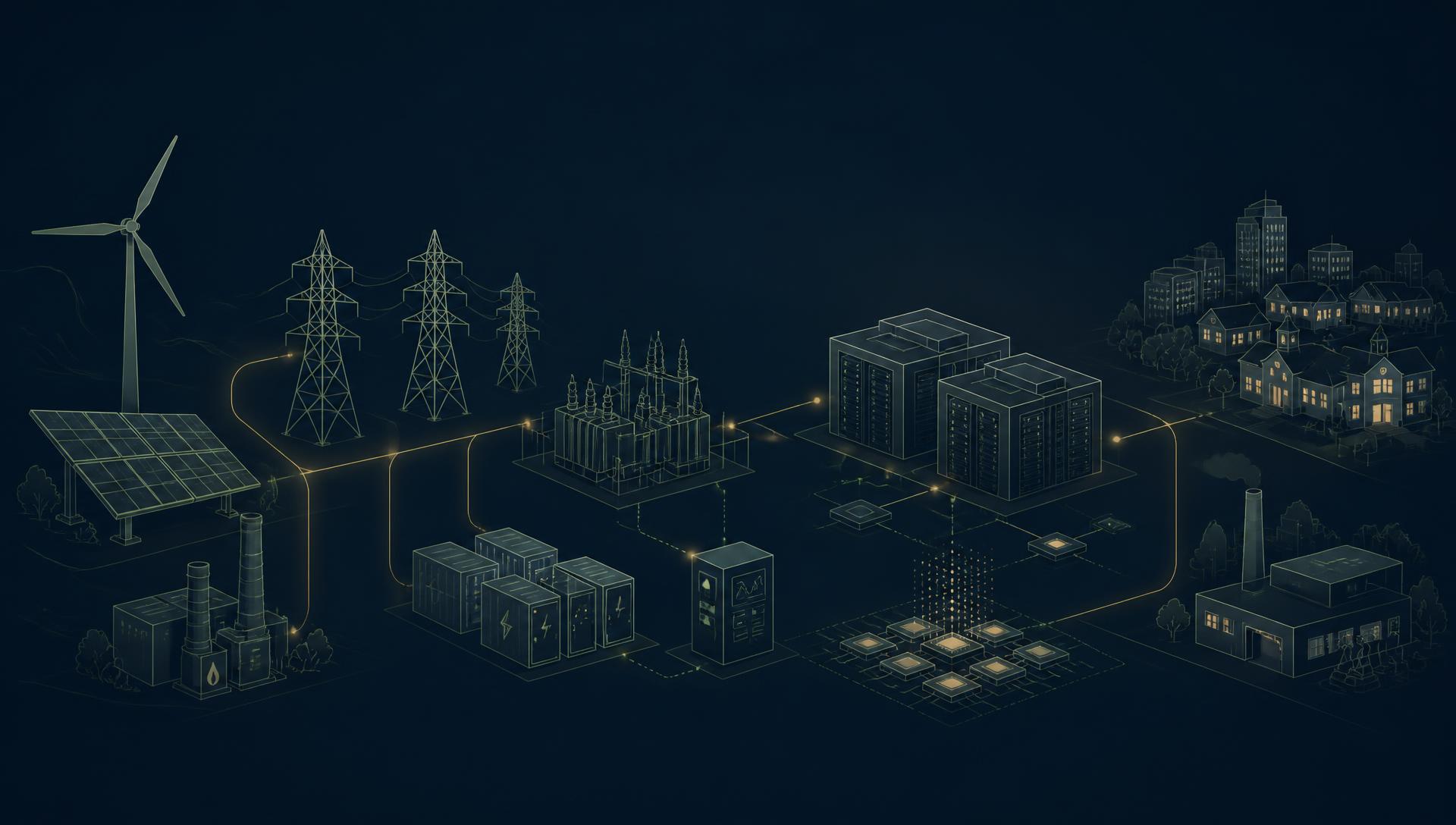
The ecosystem map

One system, read in seven layers

The recurring structure behind every issue of the series.

Figure — The AI Energy Ecosystem

Seven layers, read top to bottom: energy resources become deliverable capacity, capacity becomes compute, compute becomes intelligent output, and the result lands in a community.

  1. Energy Resources

    What can actually be generated, and when?

    Where the electricity originates, at what cost, on what schedule, and under which constraints.

    • Utility-scale and distributed generation
    • Solar, wind, and hydro resources
    • Natural gas and firm generation
    • On-site and dedicated generation
    • Fuel supply and long-term contracting
  2. Grid Infrastructure

    What can be delivered to this site, and how soon?

    The delivery system between generation and load — the layer that most often sets the schedule.

    • Transmission and distribution networks
    • Substations and service capacity
    • Interconnection queues and studies
    • Utility planning and system upgrades
    • Tariffs, rate design, and cost allocation
  3. Resilience and Flexibility

    What happens when supply and demand do not line up?

    The systems that absorb variability, shift load in time, and keep critical operations running.

    • Battery energy storage
    • Microgrids, islanding, and controls
    • Backup and standby generation
    • Demand response and load flexibility
    • Power quality and continuity of operations
  4. Digital Infrastructure

    Where does compute physically live, and what does it require?

    The physical buildings, cooling, and networks that convert electricity into compute capacity.

    • Data centers and colocation campuses
    • Cooling, water, and thermal systems
    • Fiber routes and network interconnection
    • Edge sites and regional facilities
    • Site selection and land assembly
  5. Intelligent Systems

    What is the load actually doing, and how does it behave?

    The workloads and machines that consume the capacity — and increasingly shape how it is planned.

    • AI training and inference workloads
    • Robotics and autonomous systems
    • Advanced and automated manufacturing
    • Electrified fleets and mobility
    • Operational software and controls
  6. Capital and Delivery

    Who funds it, who builds it, and on what terms?

    How projects are financed, structured, engineered, and built — the layer that turns plans into assets.

    • Developers and infrastructure funds
    • Debt, tax equity, and project finance
    • EPC firms, engineers, and contractors
    • Equipment supply and lead times
    • Ownership, offtake, and commercial structures
  7. Communities and Public Stakeholders

    Who carries the impact, and who shares in the benefit?

    The permitting, ratepayer, workforce, and land-use realities that determine what is possible locally.

    • Municipalities and county governments
    • Permitting, zoning, and siting
    • Ratepayer and affordability outcomes
    • Workforce and economic development
    • Local benefit, land use, and public trust
Original diagram by GRIDSTROM Intelligence. An editorial framework for organizing analysis — not an engineering standard or regulatory classification.

Key infrastructure layers

What each layer decides

Every layer sets a constraint the others have to work within.

Layer 01

Energy Resources

Where the electricity originates, at what cost, on what schedule, and under which constraints.

  • Utility-scale and distributed generation
  • Solar, wind, and hydro resources
  • Natural gas and firm generation
  • On-site and dedicated generation
  • Fuel supply and long-term contracting

What can actually be generated, and when?

Layer 02

Grid Infrastructure

The delivery system between generation and load — the layer that most often sets the schedule.

  • Transmission and distribution networks
  • Substations and service capacity
  • Interconnection queues and studies
  • Utility planning and system upgrades
  • Tariffs, rate design, and cost allocation

What can be delivered to this site, and how soon?

Layer 03

Resilience and Flexibility

The systems that absorb variability, shift load in time, and keep critical operations running.

  • Battery energy storage
  • Microgrids, islanding, and controls
  • Backup and standby generation
  • Demand response and load flexibility
  • Power quality and continuity of operations

What happens when supply and demand do not line up?

Layer 04

Digital Infrastructure

The physical buildings, cooling, and networks that convert electricity into compute capacity.

  • Data centers and colocation campuses
  • Cooling, water, and thermal systems
  • Fiber routes and network interconnection
  • Edge sites and regional facilities
  • Site selection and land assembly

Where does compute physically live, and what does it require?

Layer 05

Intelligent Systems

The workloads and machines that consume the capacity — and increasingly shape how it is planned.

  • AI training and inference workloads
  • Robotics and autonomous systems
  • Advanced and automated manufacturing
  • Electrified fleets and mobility
  • Operational software and controls

What is the load actually doing, and how does it behave?

Layer 06

Capital and Delivery

How projects are financed, structured, engineered, and built — the layer that turns plans into assets.

  • Developers and infrastructure funds
  • Debt, tax equity, and project finance
  • EPC firms, engineers, and contractors
  • Equipment supply and lead times
  • Ownership, offtake, and commercial structures

Who funds it, who builds it, and on what terms?

Layer 07

Communities and Public Stakeholders

The permitting, ratepayer, workforce, and land-use realities that determine what is possible locally.

  • Municipalities and county governments
  • Permitting, zoning, and siting
  • Ratepayer and affordability outcomes
  • Workforce and economic development
  • Local benefit, land use, and public trust

Who carries the impact, and who shares in the benefit?

Stakeholder groups

Written for the people who have to decide

The series is read across the full length of a project, not one discipline within it.

Data-center developers and operators

Siting, service capacity, interconnection timing, and resilience architecture.

AI, robotics, and advanced manufacturing companies

Load behavior, power availability, and what compute growth demands of the grid.

Utilities and energy providers

Load growth patterns, flexibility, rate design, and system planning pressure.

Investors and infrastructure funds

Project structure, capital conditions, delivery risk, and long-term asset value.

EPC firms, engineers, and contractors

System architecture, equipment lead times, and delivery sequencing.

Commercial property owners and developers

Where energy infrastructure changes the value and utility of a site.

Public agencies and economic-development organizations

Community outcomes, workforce effects, permitting, and public-interest trade-offs.

Technology providers and strategic partners

Where their systems fit inside a larger, integrated infrastructure picture.

Related reports

Industry Reports

Longer research documents that consolidate a full topic into a single reference — structured for circulation inside an organization and designed to be read away from a screen.

  • Full-topic synthesis with methodology stated
  • Comparison frameworks and models
  • Diagrams suitable for internal presentations
  • Downloadable, print-ready format
In preparationView the series

Related explainers

Infrastructure Explained

Clear, visual explanations of the systems behind modern energy infrastructure. Written so an engineer finds it accurate and a non-technical stakeholder finds it readable.

  • Microgrids, islanding, and controls
  • Battery energy storage sizing and duty cycles
  • Interconnection, service capacity, and upgrades
  • Distributed generation and on-site resources
The Intelligent Infrastructure ReviewAI, Energy, Data Centers and RoboticsPublished by GRIDSTROM Energy Solutions

Follow Exploring the AI Energy Ecosystem

Each issue traces one part of the AI Energy Ecosystem — generation, interconnection, storage, compute, capital, or community outcomes — and how it connects to the rest. Sent as it publishes.

Content preferences

Only what is listed above is collected. No third-party sharing. Every issue carries an unsubscribe and preference-management link.

Project inquiry

Evaluating a site, campus, or portfolio?

Share the property, load profile, or opportunity you are working through. GRIDSTROM evaluates it against the same layers the series examines.

Partnership inquiry

Building somewhere in this ecosystem?

Technology providers, developers, EPC firms, utilities, capital sources, and public agencies working across these layers are welcome to open a conversation.